Build the traceability matrix between your bid and an RFP
Objective
Build and maintain a traceability matrix showing where each numbered RFP chapter is addressed in a bid.
Prerequisites
- REQCHECKER™ PRO or an edition that includes the Coverage Matrix.
- An RFP and a bid, preferably stored in the same project folder.
- An RFP with native Word headings or another supported heading structure.
- Familiarity with the requirement statuses and coverage link syntax.
Expected result
The Coverage Matrix identifies every RFP chapter, its coverage in the bid, and any chapter that remains partially covered, uncovered, or not applicable.
Context
This tutorial solves a common problem for people who regularly write bids. The RFP – request for proposal – contains several requirements.
A Coverage Matrix between your bid and the RFP helps your customer to:
- Check that the RFP he has carefully written has been fully read and covered
- Find exactly where a requirement is taken into account in your bid
- Check where your bid does not fully fit a requirement
- Navigate between his RFP structure and your bid structure
It is therefore good practice to send such matrices. Unfortunately most RFPs have no formalized requirements. The only way to identify a sub-part of the RFP is to use the chapter numbers. In this case, you have to create a table in your bid presenting where and how each RFP chapter has been covered.
For example:
| RFP § | BID § | COMMENT |
|---|---|---|
| §1 Introduction | §1.2 Context | |
| §1.1 Overview | §1.2 Context | |
| … | … | |
| §2.4.2 Graphical User interface | §2.2.3 Rich client application | Windows platforms only are supported |
With an RFP in MS Word with few chapters (less than 20 for example), this can be done manually by:
- copying the table of contents in the first column
- completing it with lower chapter levels that are not listed in the table of contents
- manually completing the BID and COMMENT columns
However, with an RFP in PDF format where text cannot be easily copied, or with a huge RFP with hundreds of chapters, or whenever your boss asks you to update your bid chapter structure just before the end of RFP countdown time, this matrix becomes a dreadful nightmare… 🙁
Have you never dreamed of a simple method for automatically building and updating this matrix?
Reqchecker makes this possible.
Step 1 - Create a Reqchecker project
The first step consists in creating a project that includes the RFP and the proposal.
Let’s take an RFP with the following chapter structure.
1.0 Company
2.0 Purpose
3.0 Objectives
4.0 Target Audiences
5.0 Criteria for Evaluating the Success of a PR Agency
6.0 Query Handling
7.0 Accuracy
8.0 Rights Reserved
9.0 Award of Contract
10.0 Confidentiality
First of all you must create the project file. To make things easier all documents can be stored in the same folder, for example called matrix. Right click on the RFP document, then click on Add to coverage menu to create an empty project name new project.cover.
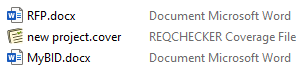
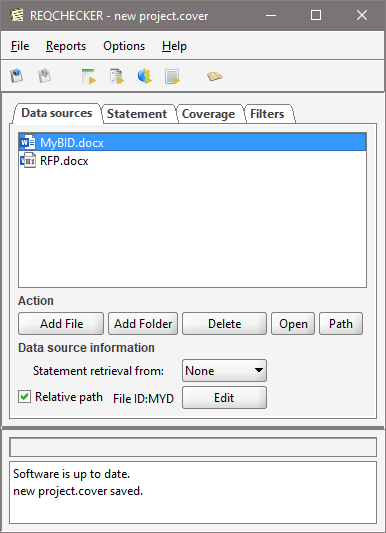
Double click on the new project.cover file to open REQCHECKER™, then:
- Select the RFP in the file list.
- Select Heading in the Data Source Information section. The RFP must use recognizable heading styles or numbering.
- Click on the Edit button and force the file code to RFP.
- Click on the Add File button.
- Select the bid file in the file browser. In this example the name is MyBID.docx.
- Select the BID file from the file list.
- Select None in the Data Source Information section to skip the heading of the bid itself.
- Click on the File menu, then Save to save your modifications.
Step 2 – Insert tags in your proposal
Insert a coverage link tag wherever your proposal answers a chapter, or part of a chapter, of the RFP.
For example, the RFP text contains the text below.
12.0 Project Duration
12.1 The project will commence on 1 February 2015, and will be completed by 31 July 2015.
12.2 Dates of commencement and completion of the project shall be stated in the contract.
Let’s imagine that the associated chapter in the proposal is the text below.
1 Overview
2 Technical proposal
3 Administrative proposal
3.1 Schedule
The project duration is 6 months. The project starts 2 weeks after order.
The estimated schedule is:
- 15th January: order
- 1st February: project kick-off
- 31th July: final delivery
<<RFP§12.0>> <<RFP§12.1>> <<RFP§12.2>>
The <<RFP§12.0>> text is the tag indicating that this chapter fully covers the requirements of RFP chapter §12.0.
To keep the proposal legible, tags are usually written in grey in a small font. Good practice recommends using a Word style. You can also use REQCHECKER™ Add-in for Microsoft Word Show / Hide Coverage Links command to hide tags.
The choice of the << >> markers and the Coverage Link tags is defined in the Coverage Links tab and can be modified. It is also possible to create a custom coverage link attribute named Comment.
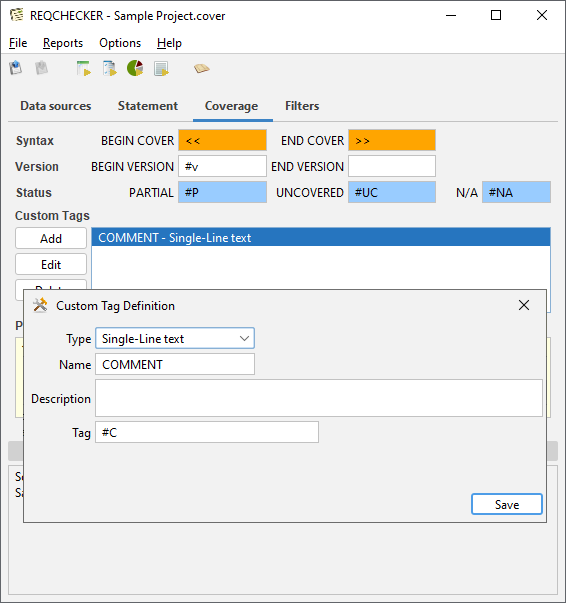
Coverage Link tags can embed more information. For example:
<<RFP§12.0>> FRAGMENTmeans that this coverage link applies to only part of the RFP chapter.<<RFP§12.0>> UNCOVEREDmeans that the chapter is managed but is not covered in the bid. The coverage rate is reduced.<<RFP§12.0>> N/Ameans that the chapter is not applicable to the bid scope. It is excluded from the coverage rate.<<RFP§12.0>> UNCOVERED 25%means that 25% of the chapter is explicitly unmanaged. Use rates only when their total is meaningful and review the resulting status.<<RFP§12.0>> #Crecords a comment in the Coverage Matrix when theCommentcustom coverage link attribute has been configured.
All of these can be combined. For example, <<RFP§12.0>> FRAGMENT 50% <<RFP§12.0>> N/A 25% <<RFP§12.0>> UNCOVERED 25% #C This will be covered by another proposal. means that 50% of this chapter is covered, 25% is not applicable, and 25% is explicitly uncovered.
Step 3 – Generate the Coverage Matrix
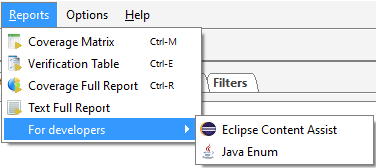
Click on the Report > Coverage Matrix menu to build the EXCEL matrix.
The first tab presents the coverage rate in a pie chart. Select the second tab Flat Matrix tab. Remove or hide unwanted columns and filter on the §12.0. The resulting display will be something like the screen below.
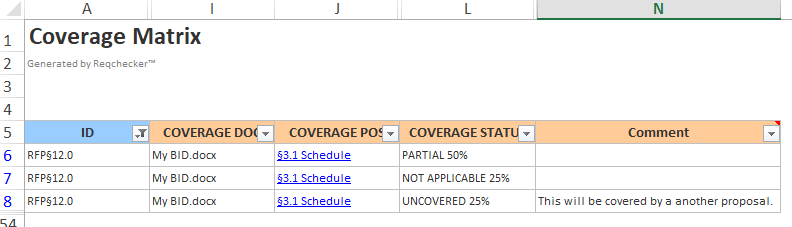
You can either copy the matrix into your proposal, or click on the Report > Printable HTML Report menu to attach or print the detailed report.
Step 4 – Update the Coverage Matrix
Replace the RFP source document with its updated version, or update the proposal, then recompute the project. Even if chapters or text move, the matrix is regenerated from the current documents within seconds.
Review the result in the Project Viewer before sending it: correct genuine coverage issues in the bid and recompute the matrix. For RFP obligations written outside numbered chapters, consider using Syntax+Full mode instead of Heading mode.
Success criteria
The matrix contains the expected RFP§ identifiers, each bid coverage points to the correct RFP chapter, and no unexpected coverage error remains.